Stoichiometry
Stoichiometry /ˌstɔɪkiˈɒmᵻtri/ is the calculation of relative quantities of reactants and products in chemical reactions.
Stoichiometry is founded on the law of conservation of mass where the total mass of the reactants equals the total mass of the products leading to the insight that the relations among quantities of reactants and products typically form a ratio of positive integers. This means that if the amounts of the separate reactants are known, then the amount of the product can be calculated. Conversely, if one reactant has a known quantity and the quantity of product can be empirically determined, then the amount of the other reactants can also be calculated.
This is illustrated in the image here, where the balanced equation is:
- CH
4 + 2 O
2 → CO
2 + 2 H
2O.
Here, one molecule of methane reacts with two molecules of oxygen gas to yield one molecule of carbon dioxide and two molecules of water. Stoichiometry measures these quantitative relationships, and is used to determine the amount of products/reactants that are produced/needed in a given reaction. Describing the quantitative relationships among substances as they participate in chemical reactions is known as reaction stoichiometry. In the example above, reaction stoichiometry measures the relationship between the methane and oxygen as they react to form carbon dioxide and water.
Because of the well known relationship of moles to atomic weights, the ratios that are arrived at by stoichiometry can be used to determine quantities by weight in a reaction described by a balanced equation. This is called composition stoichiometry.
Gas stoichiometry deals with reactions involving gases, where the gases are at a known temperature, pressure, and volume and can be assumed to be ideal gases. For gases, the volume ratio is ideally the same by the ideal gas law, but the mass ratio of a single reaction has to be calculated from the molecular masses of the reactants and products. In practice, due to the existence of isotopes, molar masses are used instead when calculating the mass ratio.The laws are as follows:
Stoichiometry - Basic Law of Chemistry
1. The Law of Conservation of Mass
In 1774, a scientist from Francis Lavoiser conducted an experiment by heating Tin and Oxygen gas in a recluse. From the results of his experiment, Lavoiser found that there was no mass change in his experiments. Then he puts the so-called Mass Conservation Law, which reads:
"In chemical reactions, the mass of reactants is equal to the mass of the reaction product"
2. Comparable Law of Comparison
In contrast to Lavoiser, Proust studied elemental elements in compounds focused on the comparison. He puts forward the law that "In a chemical reaction, the mass of a substance which reacts with a certain amount of other substances is always fixed". Consider the following example:

3. The Law of Multiple Comparisons
This law was put forward by John Dalton. He was interested. To study the elements that can form more than one type of compound. The law reads:
"If two elements can form more than one compound, then the ratio of the elemental masses to one of the other elements of a certain mass, is an integer and a simple"
Consider the following example: Carbon can form two compounds

4. Avogadro's Law
Amando Avogadro in 1811 resumed the Gay Lussac experiment. Avogadro was very interested in studying the nature of the gas and hypothesized:
"At the same temperature and pressure, all the same volumes of gas have the same number of molecules".
Example:

Converting grams to moles
Stoichiometry is not only used to balance chemical equations but also used in conversions, i.e., converting from grams to moles using molar mass as the conversion factor, or from grams to milliliters using density. For example, to find the amount of NaCl (sodium chloride) in 2.00 g, one would do the following:

In the above example, when written out in fraction form, the units of grams form a multiplicative identity, which is equivalent to one (g/g = 1), with the resulting amount in moles (the unit that was needed), as shown in the following equation,

Molar proportion
Stoichiometry is often used to balance chemical equations (reaction stoichiometry). For example, the two diatomic gases, hydrogen and oxygen, can combine to form a liquid, water, in an exothermic reaction, as described by the following equation:
- 2 H
2 + O
2 → 2 H
2O
Reaction stoichiometry describes the 2:1:2 ratio of hydrogen, oxygen, and water molecules in the above equation.
The molar ratio allows for conversion between moles of one substance and moles of another. For example, in the reaction
- 2 CH
3OH + 3 O
2 → 2 CO
2 + 4 H
2O
the amount of water that will be produced by the combustion of 0.27 moles of CH
3OH is obtained using the molar ratio between CH
3OH and H
2O of 2 to 4.
3OH is obtained using the molar ratio between CH
3OH and H
2O of 2 to 4.

The term stoichiometry is also often used for the molar proportions of elements in stoichiometric compounds (composition stoichiometry). For example, the stoichiometry of hydrogen and oxygen in H2O is 2:1. In stoichiometric compounds, the molar proportions are whole numbers.
Determining amount of product
Stoichiometry can also be used to find the quantity of a product yielded by a reaction. If a piece of solid copper (Cu) were added to an aqueous solution of silver nitrate (AgNO3), the silver (Ag) would be replaced in a single displacement reaction forming aqueous copper(II) nitrate (Cu(NO3)2) and solid silver. How much silver is produced if 16.00 grams of Cu is added to the solution of excess silver nitrate?
The following steps would be used:
- Write and balance the equation
- Mass to moles: Convert grams of Cu to moles of Cu
- Mole ratio: Convert moles of Cu to moles of Ag produced
- Mole to mass: Convert moles of Ag to grams of Ag produced
The complete balanced equation would be:
- Cu + 2 AgNO
3 → Cu(NO
3)
2 + 2 Ag
For the mass to mole step, the mass of copper (16.00 g) would be converted to moles of copper by dividing the mass of copper by its molecular mass: 63.55 g/mol.

Now that the amount of Cu in moles (0.2518) is found, we can set up the mole ratio. This is found by looking at the coefficients in the balanced equation: Cu and Ag are in a 1:2 ratio.

Now that the moles of Ag produced is known to be 0.5036 mol, we convert this amount to grams of Ag produced to come to the final answer:

This set of calculations can be further condensed into a single step:

Further examples[edit]
For propane (C3H8) reacting with oxygen gas (O2), the balanced chemical equation is:
- C
3H
8 + 5 O
2 → 3 CO
2 + 4 H
2O
The mass of water formed if 120 g of propane (C3H8) is burned in excess oxygen is then

Stoichiometric ratio
Stoichiometry is also used to find the right amount of one reactant to "completely" react with the other reactant in a chemical reaction – that is, the stoichiometric amounts that would result in no leftover reactants when the reaction takes place. An example is shown below using the thermite reaction,
- Fe
2O
3 + 2 Al → Al
2O
3 + 2 Fe
This equation shows that 1 mole of iron(III) oxide and 2 moles of aluminum will produce 1 mole of aluminium oxide and 2 moles of iron. So, to completely react with 85.0 g of iron(III) oxide (0.532 mol), 28.7 g (1.06 mol) of aluminium are needed.

Limiting reagent and percent yield
The limiting reagent is the reagent that limits the amount of product that can be formed and is completely consumed when the reaction is complete. An excess reactant is a reactant that is left over once the reaction has stopped due to the limiting reactant being exhausted.
Consider the equation of roasting lead(II) sulfide (PbS) in oxygen (O2) to produce lead(II) oxide (PbO) and sulfur dioxide (SO2):
- 2 PbS + 3 O
2 → 2 PbO + 2 SO
2
To determine the theoretical yield of lead(II) oxide if 200.0 g of lead(II) sulfide and 200.0 g of oxygen are heated in an open container:


Because a lesser amount of PbO is produced for the 200.0 g of PbS, it is clear that PbS is the limiting reagent.
In reality, the actual yield is not the same as the stoichiometrically-calculated theoretical yield. Percent yield, then, is expressed in the following equation:

If 170.0 g of lead(II) oxide is obtained, then the percent yield would be calculated as follows:

Example
Consider the following reaction, in which iron(III) chloride reacts with hydrogen sulfide to produce iron(III) sulfide and hydrogen chloride:
- 2 FeCl
3 + 3 H
2S → Fe
2S
3 + 6 HCl
Suppose 90.0 g of FeCl3 reacts with 52.0 g of H2S. To find the limiting reagent and the mass of HCl produced by the reaction, we could set up the following equations:


Thus, the limiting reagent is FeCl3 and the amount of HCl produced is 60.8 g.
To find what mass of excess reagent (H2S) remains after the reaction, we would set up the calculation to find out how much H2S reacts completely with the 90.0 g FeCl3:

By subtracting this amount from the original amount of H2S, we can come to the answer:

Different stoichiometries in competing reactions
Often, more than one reaction is possible given the same starting materials. The reactions may differ in their stoichiometry. For example, the methylation of benzene (C6H6), through a Friedel–Crafts reaction using AlCl3 as a catalyst, may produce singly methylated (C6H5CH3), doubly methylated (C6H4(CH3)2), or still more highly methylated (C6H6−n(CH3)n) products, as shown in the following example,
- C6H6 + CH3Cl → C6H5CH3 + HCl
- C6H6 + 2 CH3Cl → C6H4(CH3)2 + 2 HCl
- C6H6 + n CH3Cl → C6H6−n(CH3)n + n HCl
In this example, which reaction takes place is controlled in part by the relative concentrations of the reactants.
Stoichiometric coefficient
In lay terms, the stoichiometric coefficient (or stoichiometric number in the IUPAC nomenclature[3]) of any given component is the number of molecules that participate in the reaction as written.
For example, in the reaction CH4 + 2 O2 → CO2 + 2 H2O, the stoichiometric coefficient of CH4 is −1, the stoichiometric coefficient of O2 is −2, for CO2 it would be +1 and for H2O it is +2.
In more technically precise terms, the stoichiometric coefficient in a chemical reaction system of the ith component is defined as

or

The stoichiometric coefficient νi represents the degree to which a chemical species participates in a reaction. The convention is to assign negative coefficients to reactants (which are consumed) and positive ones to products. However, any reaction may be viewed as going in the reverse direction, and all the coefficients then change sign (as does the free energy). Whether a reaction actually will go in the arbitrarily selected forward direction or not depends on the amounts of the substances present at any given time, which determines the kinetics and thermodynamics, i.e., whether equilibrium lies to the right or the left.
In reaction mechanisms, stoichiometric coefficients for each step are always integers, since elementary reactions always involve whole molecules. If one uses a composite representation of an overall reaction, some may be rational fractions. There are often chemical species present that do not participate in a reaction; their stoichiometric coefficients are therefore zero. Any chemical species that is regenerated, such as a catalyst, also has a stoichiometric coefficient of zero.
The simplest possible case is an isomerization
- A → B
in which νB = 1 since one molecule of B is produced each time the reaction occurs, while νA = −1 since one molecule of A is necessarily consumed. In any chemical reaction, not only is the total mass conserved but also the numbers of atoms of each kind are conserved, and this imposes corresponding constraints on possible values for the stoichiometric coefficients.
There are usually multiple reactions proceeding simultaneously in any natural reaction system, including those in biology. Since any chemical component can participate in several reactions simultaneously, the stoichiometric coefficient of the ith component in the kth reaction is defined as

so that the total (differential) change in the amount of the ith component is
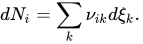
Extents of reaction provide the clearest and most explicit way of representing compositional change, although they are not yet widely used.
With complex reaction systems, it is often useful to consider both the representation of a reaction system in terms of the amounts of the chemicals present { Ni } (state variables), and the representation in terms of the actual compositional degrees of freedom, as expressed by the extents of reaction { ξk }. The transformation from a vector expressing the extents to a vector expressing the amounts uses a rectangular matrix whose elements are the stoichiometric coefficients [ νi k ].
The maximum and minimum for any ξk occur whenever the first of the reactants is depleted for the forward reaction; or the first of the "products" is depleted if the reaction as viewed as being pushed in the reverse direction. This is a purely kinematic restriction on the reaction simplex, a hyperplane in composition space, or N‑space, whose dimensionality equals the number of linearly-independent chemical reactions. This is necessarily less than the number of chemical components, since each reaction manifests a relation between at least two chemicals. The accessible region of the hyperplane depends on the amounts of each chemical species actually present, a contingent fact. Different such amounts can even generate different hyperplanes, all sharing the same algebraic stoichiometry.
In accord with the principles of chemical kinetics and thermodynamic equilibrium, every chemical reaction is reversible, at least to some degree, so that each equilibrium point must be an interior point of the simplex. As a consequence, extrema for the ξs will not occur unless an experimental system is prepared with zero initial amounts of some products.
The number of physically-independent reactions can be even greater than the number of chemical components, and depends on the various reaction mechanisms. For example, there may be two (or more) reaction paths for the isomerism above. The reaction may occur by itself, but faster and with different intermediates, in the presence of a catalyst.
The (dimensionless) "units" may be taken to be molecules or moles. Moles are most commonly used, but it is more suggestive to picture incremental chemical reactions in terms of molecules. The Ns and ξs are reduced to molar units by dividing by Avogadro's number. While dimensional mass units may be used, the comments about integers are then no longer applicable.
Stoichiometry matrix
In complex reactions, stoichiometries are often represented in a more compact form called the stoichiometry matrix. The stoichiometry matrix is denoted by the symbol N.
If a reaction network has n reactions and m participating molecular species then the stoichiometry matrix will have correspondingly m rows and n columns.
For example, consider the system of reactions shown below:
- S1 → S2
- 5 S3 + S2 → 4 S3 + 2 S2
- S3 → S4
- S4 → S5
This systems comprises four reactions and five different molecular species. The stoichiometry matrix for this system can be written as:
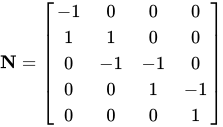
where the rows correspond to S1, S2, S3, S4 and S5, respectively. Note that the process of converting a reaction scheme into a stoichiometry matrix can be a lossy transformation, for example, the stoichiometries in the second reaction simplify when included in the matrix. This means that it is not always possible to recover the original reaction scheme from a stoichiometry matrix.
Often the stoichiometry matrix is combined with the rate vector, v, and the species vector, S to form a compact equation describing the rates of change of the molecular species:
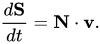
Gas stoichiometry
Gas stoichiometry is the quantitative relationship (ratio) between reactants and products in a chemical reaction with reactions that produce gases. Gas stoichiometry applies when the gases produced are assumed to be ideal, and the temperature, pressure, and volume of the gases are all known. The ideal gas law is used for these calculations. Often, but not always, the standard temperature and pressure (STP) are taken as 0 °C and 1 bar and used as the conditions for gas stoichiometric calculations.
Gas stoichiometry calculations solve for the unknown volume or mass of a gaseous product or reactant. For example, if we wanted to calculate the volume of gaseous NO2produced from the combustion of 100 g of NH3, by the reaction:
- 4 NH
3(g) + 7 O
2(g) → 4 NO
2(g) + 6 H
2O(l)
we would carry out the following calculations:

There is a 1:1 molar ratio of NH3 to NO2 in the above balanced combustion reaction, so 5.871 mol of NO2 will be formed. We will employ the ideal gas law to solve for the volume at 0 °C (273.15 K) and 1 atmosphere using the gas law constant of R = 0.08206 L·atm·K−1·mol−1 :
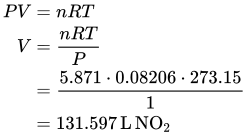
Gas stoichiometry often involves having to know the molar mass of a gas, given the density of that gas. The ideal gas law can be re-arranged to obtain a relation between the density and the molar mass of an ideal gas:
- and


and thus:

where:
- P = absolute gas pressure
- V = gas volume
- n = amount (measured in moles)
- R = universal ideal gas law constant
- T = absolute gas temperature
- ρ = gas density at T and P
- m = mass of gas
- M = molar mass of gas
Stoichiometric air-to-fuel ratios of common fuels
In the combustion reaction, oxygen reacts with the fuel, and the point where exactly all oxygen is consumed and all fuel burned is defined as the stoichiometric point. With more oxygen (overstoichiometric combustion), some of it stays unreacted. Likewise, if the combustion is incomplete due to lack of sufficient oxygen, fuel remains unreacted. (Unreacted fuel may also remain because of slow combustion or insufficient mixing of fuel and oxygen – this is not due to stoichiometry). Different hydrocarbon fuels have different contents of carbon, hydrogen and other elements, thus their stoichiometry varies.
| Fuel | Ratio by mass | Ratio by volume | Percent fuel by mass |
|---|---|---|---|
| Gasoline | 14.7 : 1 | — | 6.8% |
| Natural gas | 17.2 : 1 | 9.7 : 1 | 5.8% |
| Propane (LP) | 15.67 : 1 | 23.9 : 1 | 6.45% |
| Ethanol | 9 : 1 | — | 11.1% |
| Methanol | 6.47 : 1 | — | 15.6% |
| n-Butanol | 11.2 : 1 | — | 8.2% |
| Hydrogen | 34.3 : 1 | 2.39 : 1 | 2.9% |
| Diesel | 14.5 : 1 | — | 6.8% |
| Methane | 17.19 : 1 | 9.52 : 1 | 5.5% |
Gasoline engines can run at stoichiometric air-to-fuel ratio, because gasoline is quite volatile and is mixed (sprayed or carburetted) with the air prior to ignition. Diesel engines, in contrast, run lean, with more air available than simple stoichiometry would require. Diesel fuel is less volatile and is effectively burned as it is injected, leaving less time for evaporation and mixing. Thus, it would form soot (black smoke) at stoichiometric ratio.

What is law was put forward by John Dalton?
BalasHapus"If two elements can form more than one compound, then the ratio of the elemental masses to one of the other elements of a certain mass, is an integer and a simple"
Hapuswhat is the mole fomula?
BalasHapusn = gram/mr
HapusWhat is the formula for finding a volume?
BalasHapusv = n/M ; v= volume, n = mole, M = molarity
Hapusplease explain about Avogadro law ? thanks
BalasHapusAvogadro's Law (Hypotes Avogadro, or Avogadro's Principle) is a gas law named after the Italian scientist Amedeo Avogadro, who in 1811 proposed the hypothesis that:
HapusGases of the same volume, at the same temperature and pressure, have the same number of particles.
That is, the number of molecules or atoms in a gas volume does not depend on the size or mass of the gas molecule. For example, 1 liter of hydrogen and nitrogen gas will contain the same number of molecules, as long as the temperature and pressure are the same. This aspect can be expressed mathematically,
{\ Displaystyle \ qquad {{V} \ over {n}} = k} {\ displaystyle \ qquad {{V} \ over {n}} = k}.
Where:
V is the volume of gas.
N is the number of moles in the gas.
K is a matching constant.
The most important effect of Avogadro's law is that the ideal gas constant has the same value for all gases. That is, constants
{\ Displaystyle {\ frac {p_ {1} \ cdot V_ {1}} {T_ {1} \ cdot n_ {1}}} = {\ frac {p_ {2} \ cdot V_ {2}} {T_ { 2} \ cdot n_ {2}}} = const} {\ displaystyle {\ frac {p_ {1} \ cdot V_ {1}} {T_ {1} \ cdot n_ {1}}} = {\ frac {p_ {2} \ cdot V_ {2}} {T_ {2} \ cdot n_ {2}}} = const}
Where:
P is the gas pressure
T is temperature
Has the same value for all gases, independent of the size or mass of the gas molecule. The Avogadro hypothesis is evidenced by the theory of gas kinetics.
One mole of ideal gas has a 22.4 liters volume under standard conditions (STP), and this number is often called the ideal gas molar volume. Real gases (non-ideal) have different values.
Please explain about Stoichiometry is a subject in chemistry that studies the quantity of matter in a chemical reaction?'
BalasHapusstoichiometry is a chemical calculation involving the quantitative relation of substances involved in the reaction. Stoichiometry includes basic chemical laws that indicate quantitative relationships within it
Hapus