CLASSIFICATION OF MATTER
CLASSIFICATION OF MATTER
Matter is defined as anything
that occupies space and has mass, and it is all around us. Solids and
liquids are more obviously matter: We can see that they take up space,
and their weight tells us that they have mass. Gases are also matter; if
gases did not take up space, a balloon would stay collapsed rather than
inflate when filled with gas.
Solids, liquids, and gases are the three states of matter commonly found on earth (Figure 1). A solid is rigid and possesses a definite shape. A liquid
flows and takes the shape of a container, except that it forms a flat
or slightly curved upper surface when acted upon by gravity. (In zero
gravity, liquids assume a spherical shape.) Both liquid and solid
samples have volumes that are very nearly independent of pressure. A gas takes both the shape and volume of its container.
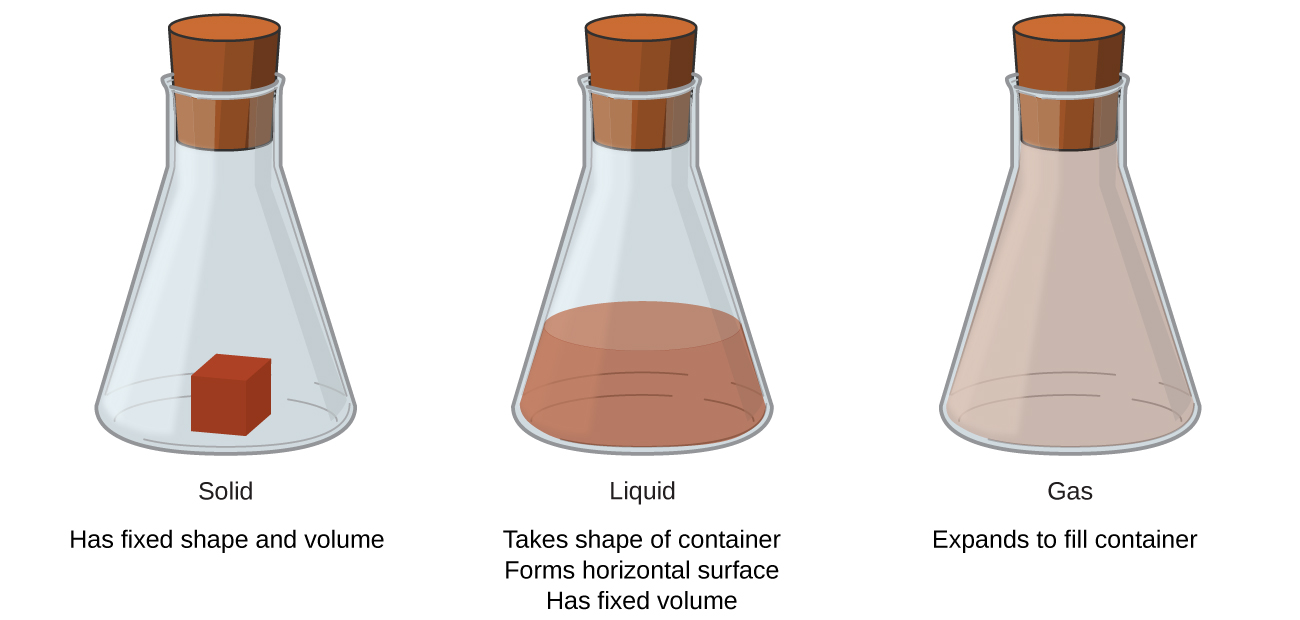
Figure 1. The three most common states or phases of matter are solid, liquid, and gas.
A fourth state of matter, plasma, occurs naturally in the interiors of stars. A plasma is a gaseous state of matter that contains appreciable numbers of electrically charged particles (Figure 2).
The presence of these charged particles imparts unique properties to
plasmas that justify their classification as a state of matter distinct
from gases. In addition to stars, plasmas are found in some other
high-temperature environments (both natural and man-made), such as
lightning strikes, certain television screens, and specialized
analytical instruments used to detect trace amounts of metals.

Figure 2. A plasma torch can be used to cut metal. (credit: “Hypertherm”/Wikimedia Commons)
In a tiny cell in a plasma television, the
plasma emits ultraviolet light, which in turn causes the display at
that location to appear a specific color. The composite of these tiny
dots of color makes up the image that you see. Watch this video to learn more about plasma and the places you encounter it.
Some samples of matter appear to have properties
of solids, liquids, and/or gases at the same time. This can occur when
the sample is composed of many small pieces. For example, we can pour
sand as if it were a liquid because it is composed of many small grains
of solid sand. Matter can also have properties of more than one state
when it is a mixture, such as with clouds. Clouds appear to behave
somewhat like gases, but they are actually mixtures of air (gas) and
tiny particles of water (liquid or solid).
The mass of an object is a
measure of the amount of matter in it. One way to measure an object’s
mass is to measure the force it takes to accelerate the object. It takes
much more force to accelerate a car than a bicycle because the car has
much more mass. A more common way to determine the mass of an object is
to use a balance to compare its mass with a standard mass.
Although weight is related to mass, it is not the same thing. Weight
refers to the force that gravity exerts on an object. This force is
directly proportional to the mass of the object. The weight of an object
changes as the force of gravity changes, but its mass does not. An
astronaut’s mass does not change just because she goes to the moon. But
her weight on the moon is only one-sixth her earth-bound weight because
the moon’s gravity is only one-sixth that of the earth’s. She may feel
“weightless” during her trip when she experiences negligible external
forces (gravitational or any other), although she is, of course, never
“massless.”
The law of conservation of matter summarizes many scientific observations about matter: It states that there
is no detectable change in the total quantity of matter present when
matter converts from one type to another (a chemical change) or changes
among solid, liquid, or gaseous states (a physical change). Brewing beer and the operation of batteries provide examples of the conservation of matter (Figure 3).
During the brewing of beer, the ingredients (water, yeast, grains,
malt, hops, and sugar) are converted into beer (water, alcohol,
carbonation, and flavoring substances) with no actual loss of substance.
This is most clearly seen during the bottling process, when glucose
turns into ethanol and carbon dioxide, and the total mass of the
substances does not change. This can also be seen in a lead-acid car
battery: The original substances (lead, lead oxide, and sulfuric acid),
which are capable of producing electricity, are changed into other
substances (lead sulfate and water) that do not produce electricity,
with no change in the actual amount of matter.
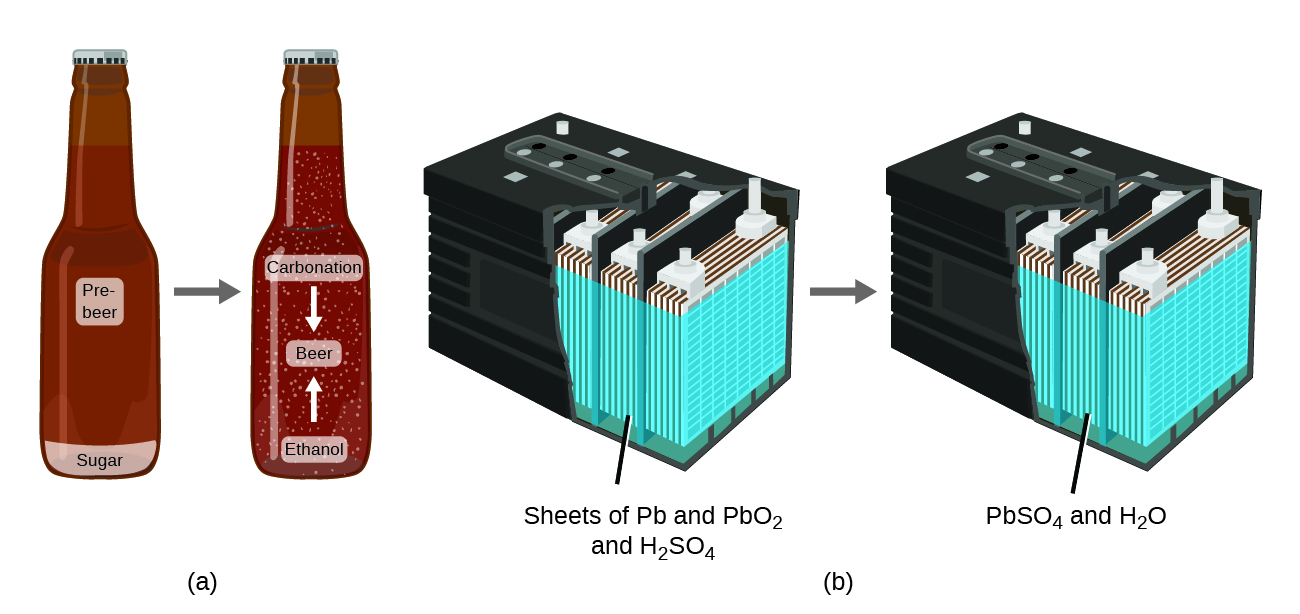
Figure 3. (a) The mass of
beer precursor materials is the same as the mass of beer produced: Sugar
has become alcohol and carbonation. (b) The mass of the lead, lead
oxide plates, and sulfuric acid that goes into the production of
electricity is exactly equal to the mass of lead sulfate and water that
is formed.
Although this conservation law holds true for
all conversions of matter, convincing examples are few and far between
because, outside of the controlled conditions in a laboratory, we seldom
collect all of the material that is produced during a particular
conversion. For example, when you eat, digest, and assimilate food, all
of the matter in the original food is preserved. But because some of the
matter is incorporated into your body, and much is excreted as various
types of waste, it is challenging to verify by measurement.
Atoms and Molecules
An atom is the smallest particle
of an element that has the properties of that element and can enter
into a chemical combination. Consider the element gold, for example.
Imagine cutting a gold nugget in half, then cutting one of the halves in
half, and repeating this process until a piece of gold remained that
was so small that it could not be cut in half (regardless of how tiny
your knife may be). This minimally sized piece of gold is an atom (from
the Greek atomos, meaning “indivisible”) (Figure 4). This atom would no longer be gold if it were divided any further.
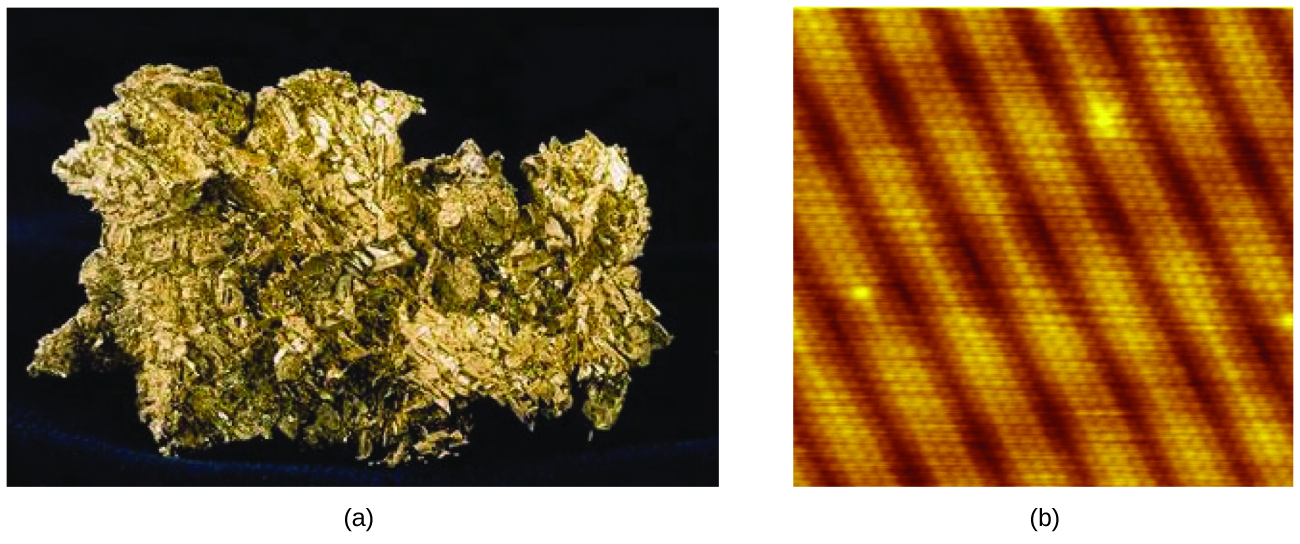
Figure 4. (a) This
photograph shows a gold nugget. (b) A scanning-tunneling microscope
(STM) can generate views of the surfaces of solids, such as this image
of a gold crystal. Each sphere represents one gold atom. (credit a:
modification of work by United States Geological Survey; credit b:
modification of work by “Erwinrossen”/Wikimedia Commons)
The first suggestion that matter is composed of
atoms is attributed to the Greek philosophers Leucippus and Democritus,
who developed their ideas in the 5th century BCE. However, it was not
until the early nineteenth century that John Dalton
(1766–1844), a British schoolteacher with a keen interest in science,
supported this hypothesis with quantitative measurements. Since that
time, repeated experiments have confirmed many aspects of this
hypothesis, and it has become one of the central theories of chemistry.
Other aspects of Dalton’s atomic theory are still used but with minor
revisions (details of Dalton’s theory are provided in the chapter on
atoms and molecules).
An atom is so small that its size is difficult to
imagine. One of the smallest things we can see with our unaided eye is a
single thread of a spider web: These strands are about 1/10,000 of a
centimeter (0.0001 cm) in diameter. Although the cross-section of one
strand is almost impossible to see without a microscope, it is huge on
an atomic scale. A single carbon atom in the web has a diameter of about
0.000000015 centimeter, and it would take about 7000 carbon atoms to
span the diameter of the strand. To put this in perspective, if a carbon
atom were the size of a dime, the cross-section of one strand would be
larger than a football field, which would require about 150 million
carbon atom “dimes” to cover it. (Figure 5) shows increasingly close microscopic and atomic-level views of ordinary cotton.
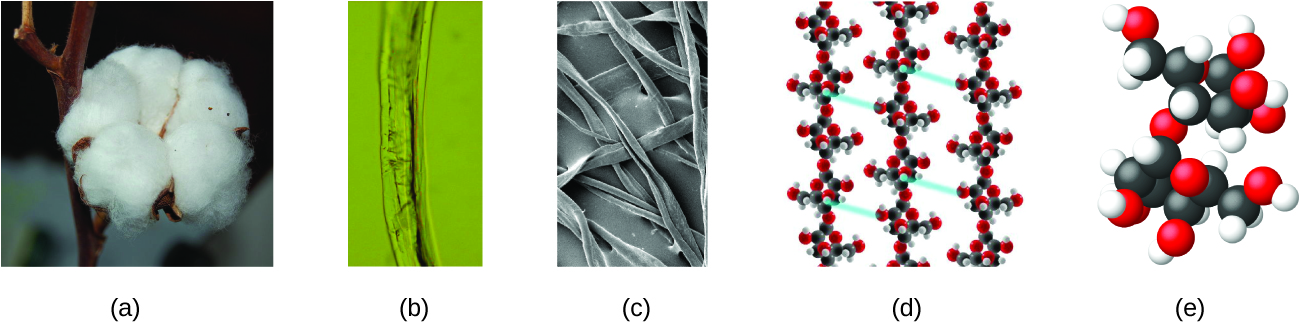
Figure 5. These images
provide an increasingly closer view: (a) a cotton boll, (b) a single
cotton fiber viewed under an optical microscope (magnified 40 times),
(c) an image of a cotton fiber obtained with an electron microscope
(much higher magnification than with the optical microscope); and (d and
e) atomic-level models of the fiber (spheres of different colors
represent atoms of different elements). (credit c: modification of work
by “Featheredtar”/Wikimedia Commons)
An atom is so light that its mass is also difficult to imagine. A billion lead atoms (1,000,000,000 atoms) weigh about 3 × 10⁻¹³
grams, a mass that is far too light to be weighed on even the world’s
most sensitive balances. It would require over 300,000,000,000,000 lead
atoms (300 trillion, or 3 × 10¹⁴) to be weighed, and they would weigh only 0.0000001 gram.
It is rare to find collections of individual
atoms. Only a few elements, such as the gases helium, neon, and argon,
consist of a collection of individual atoms that move about
independently of one another. Other elements, such as the gases
hydrogen, nitrogen, oxygen, and chlorine, are composed of units that
consist of pairs of atoms (Figure 6).
One form of the element phosphorus consists of units composed of four
phosphorus atoms. The element sulfur exists in various forms, one of
which consists of units composed of eight sulfur atoms. These units are
called molecules. A molecule consists of two or more
atoms joined by strong forces called chemical bonds. The atoms in a
molecule move around as a unit, much like the cans of soda in a six-pack
or a bunch of keys joined together on a single key ring. A molecule may
consist of two or more identical atoms, as in the molecules found in
the elements hydrogen, oxygen, and sulfur, or it may consist of two or
more different atoms, as in the molecules found in water. Each water
molecule is a unit that contains two hydrogen atoms and one oxygen atom.
Each glucose molecule is a unit that contains 6 carbon atoms, 12
hydrogen atoms, and 6 oxygen atoms. Like atoms, molecules are incredibly
small and light. If an ordinary glass of water were enlarged to the
size of the earth, the water molecules inside it would be about the size
of golf balls.
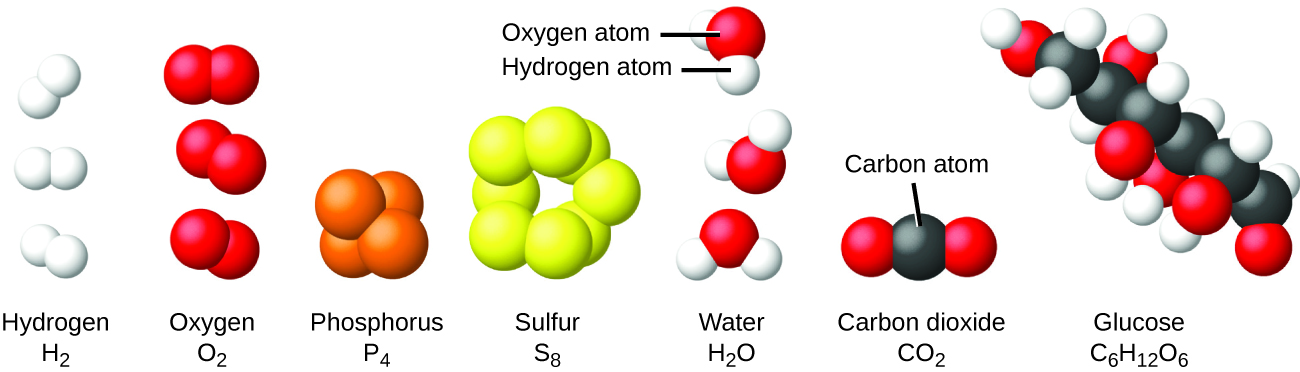
Figure 6. The elements
hydrogen, oxygen, phosphorus, and sulfur form molecules consisting of
two or more atoms of the same element. The compounds water, carbon
dioxide, and glucose consist of combinations of atoms of different
elements.
Classifying Matter
We can classify matter into several categories. Two broad categories are mixtures and pure substances. A pure substance
has a constant composition. All specimens of a pure substance have
exactly the same makeup and properties. Any sample of sucrose (table
sugar) consists of 42.1% carbon, 6.5% hydrogen, and 51.4% oxygen by
mass. Any sample of sucrose also has the same physical properties, such
as melting point, color, and sweetness, regardless of the source from
which it is isolated.
We can divide pure substances into two classes:
elements and compounds. Pure substances that cannot be broken down into
simpler substances by chemical changes are called elements.
Iron, silver, gold, aluminum, sulfur, oxygen, and copper are familiar
examples of the more than 100 known elements, of which about 90 occur
naturally on the earth, and two dozen or so have been created in
laboratories.
Pure substances that can be broken down by chemical changes are called compounds.
This breakdown may produce either elements or other compounds, or both.
Mercury(II) oxide, an orange, crystalline solid, can be broken down by
heat into the elements mercury and oxygen (Figure 7).
When heated in the absence of air, the compound sucrose is broken down
into the element carbon and the compound water. (The initial stage of
this process, when the sugar is turning brown, is known as
caramelization—this is what imparts the characteristic sweet and nutty
flavor to caramel apples, caramelized onions, and caramel). Silver(I)
chloride is a white solid that can be broken down into its elements,
silver and chlorine, by absorption of light. This property is the basis
for the use of this compound in photographic films and photochromic
eyeglasses (those with lenses that darken when exposed to light).
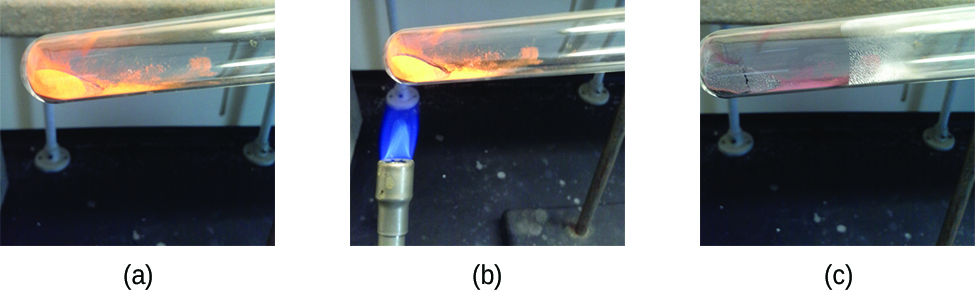
Figure 7. (a) The compound
mercury(II) oxide, (b) when heated, (c) decomposes into silvery droplets
of liquid mercury and invisible oxygen gas. (credit: modification of
work by Paul Flowers)
Many compounds break down when heated. This site shows the breakdown of mercury oxide, HgO. You can also view an example of the photochemical decomposition of silver chloride (AgCl), the basis of early photography.
The properties of combined elements are different
from those in the free, or uncombined, state. For example, white
crystalline sugar (sucrose) is a compound resulting from the chemical
combination of the element carbon, which is a black solid in one of its
uncombined forms, and the two elements hydrogen and oxygen, which are
colorless gases when uncombined. Free sodium, an element that is a soft,
shiny, metallic solid, and free chlorine, an element that is a
yellow-green gas, combine to form sodium chloride (table salt), a
compound that is a white, crystalline solid.
A mixture is composed of two or
more types of matter that can be present in varying amounts and can be
separated by physical changes, such as evaporation (you will learn more
about this later). A mixture with a composition that varies from point
to point is called a heterogeneous mixture. Italian dressing is an example of a heterogeneous mixture (Figure 8).
Its composition can vary because we can make it from varying amounts of
oil, vinegar, and herbs. It is not the same from point to point
throughout the mixture—one drop may be mostly vinegar, whereas a
different drop may be mostly oil or herbs because the oil and vinegar
separate and the herbs settle. Other examples of heterogeneous mixtures
are chocolate chip cookies (we can see the separate bits of chocolate,
nuts, and cookie dough) and granite (we can see the quartz, mica,
feldspar, and more).
A homogeneous mixture, also called a solution,
exhibits a uniform composition and appears visually the same
throughout. An example of a solution is a sports drink, consisting of
water, sugar, coloring, flavoring, and electrolytes mixed together
uniformly (Figure 8).
Each drop of a sports drink tastes the same because each drop contains
the same amounts of water, sugar, and other components. Note that the
composition of a sports drink can vary—it could be made with somewhat
more or less sugar, flavoring, or other components, and still be a
sports drink. Other examples of homogeneous mixtures include air, maple
syrup, gasoline, and a solution of salt in water.
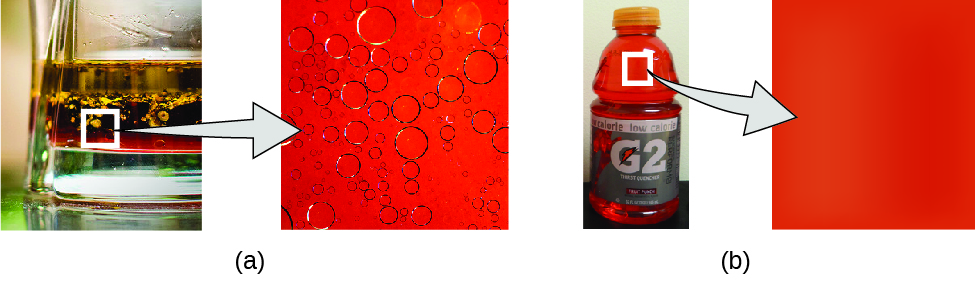
Figure 8. (a) Oil and
vinegar salad dressing is a heterogeneous mixture because its
composition is not uniform throughout. (b) A commercial sports drink is a
homogeneous mixture because its composition is uniform throughout.
(credit a “left”: modification of work by John Mayer; credit a “right”:
modification of work by Umberto Salvagnin; credit b “left: modification
of work by Jeff Bedford)
Although there are just over 100 elements, tens
of millions of chemical compounds result from different combinations of
these elements. Each compound has a specific composition and possesses
definite chemical and physical properties by which we can distinguish it
from all other compounds. And, of course, there are innumerable ways to
combine elements and compounds to form different mixtures. A summary of
how to distinguish between the various major classifications of matter
is shown in (Figure 9).
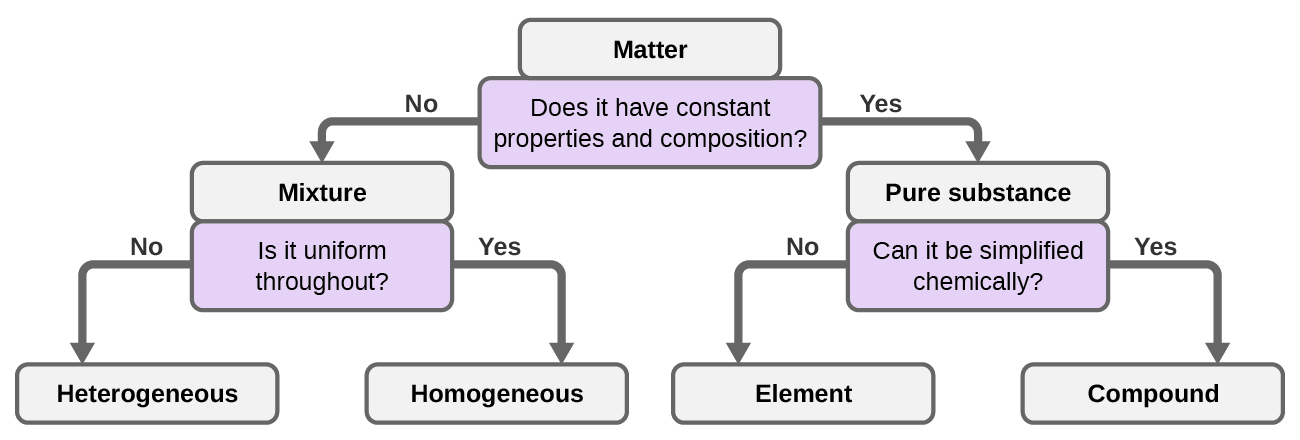
Figure 9. Depending on its
properties, a given substance can be classified as a homogeneous
mixture, a heterogeneous mixture, a compound, or an element.
Eleven elements make up about 99% of the earth’s crust and atmosphere (Table 1).
Oxygen constitutes nearly one-half and silicon about one-quarter of the
total quantity of these elements. A majority of elements on earth are
found in chemical combinations with other elements; about one-quarter of
the elements are also found in the free state.
| Element | Symbol | Percent Mass | Element | Symbol | Percent Mass | |
|---|---|---|---|---|---|---|
| oxygen | O | 49.20 | chlorine | Cl | 0.19 | |
| silicon | Si | 25.67 | phosphorus | P | 0.11 | |
| aluminum | Al | 7.50 | manganese | Mn | 0.09 | |
| iron | Fe | 4.71 | carbon | C | 0.08 | |
| calcium | Ca | 3.39 | sulfur | S | 0.06 | |
| sodium | Na | 2.63 | barium | Ba | 0.04 | |
| potassium | K | 2.40 | nitrogen | N | 0.03 | |
| magnesium | Mg | 1.93 | fluorine | F | 0.03 | |
| hydrogen | H | 0.87 | strontium | Sr | 0.02 | |
| titanium | Ti | 0.58 | all others | – | 0.47 | |
| Table 1. Elemental Composition of Earth | ||||||

hello dhea.... If you have 11 protons and 12 neutrons this is an atom of what element?
BalasHapusHi Iin, thaks for yor question, whether i'll answer your question if it consists 11 protons and 12 neutrons is an atom of element sodium (Na), in which the atomic number =11 and atomic mass = 23, so to find a neutron we can reduce the atomic mass with atomic number(proton) in order to get 23 - 11 = 12. thank you
Hapushi dea...
BalasHapusDoes that cause a substance can be dissolved in a homogeneous mixture? may try to exemplify and explain?
Thank You
Hi Maya, okey thanks for your question, i'll answer your question does that cause a substance can be dissolved in homoogeneous mixture. The homogeneous mixture (the same composition) is, of equal mixture (particle size), there is no boundary between the solvent and the solute (indirectly distinguishable between the solvent and the solute), the constituent particles of the same size (both ion , Atoms, or molecules) of two or more substances. In a liquid phase solution, the solvent is a liquid, and a solute in it is called a solute, may be solid, liquid, or gas. Thus, solution = solvent (solvent) + solute. Especially for the liquid solution, the solvent is the largest volume. An example of a homogeneous substance is pure silicon, which contains only silicon atoms. Another example is pure water, which contains only the H2O compound, or table salt, which contains only the NaCl compound.
HapusCan you explain about differented solids, liquids, and gas ? Thanks
BalasHapusAyu nur k
A solid state of matter characterized denganpartikel arranged so that the shape and volume of their relatively stabil.Unsur a solid tends to be packed together more closely than the particles in a gas or cairan.Contoh: brick, sepotongkayu, aluminiumKebanyakan metal piece of metal, such as aluminum , are solids at temperatures kamarCairan is one piece of material. The particles in a flowing liquid, so while liquids have definite volume, not have the form pasti.Contoh: at room temperature: water, mercury, vegetable oil, etanolMerkuri a heavy silver metal which is liquid at temperatures kamarGas is a state of matter consisting of particles having a volume not specified or form didefinisikan.Contoh: air, chlorine at room temperature and pressure, ozone
HapusA solid state of matter characterized denganpartikel arranged so that the shape and volume of their relatively stabil.Unsur a solid tends to be packed together more closely than the particles in a gas or cairan.Contoh: brick, sepotongkayu, aluminiumKebanyakan metal piece of metal, such as aluminum , are solids at temperatures kamarCairan is one piece of material. The particles in a flowing liquid, so while liquids have definite volume, not have the form pasti.Contoh: at room temperature: water, mercury, vegetable oil, etanolMerkuri a heavy silver metal which is liquid at temperatures kamarGas is a state of matter consisting of particles having a volume not specified or form didefinisikan.Contoh: air, chlorine at room temperature and pressure, ozone
HapusWhat are the properties of the compound?
BalasHapusDescribe the components of the elements? And why can not the uterus be divided again?
BalasHapus